Uranus: On His Way!
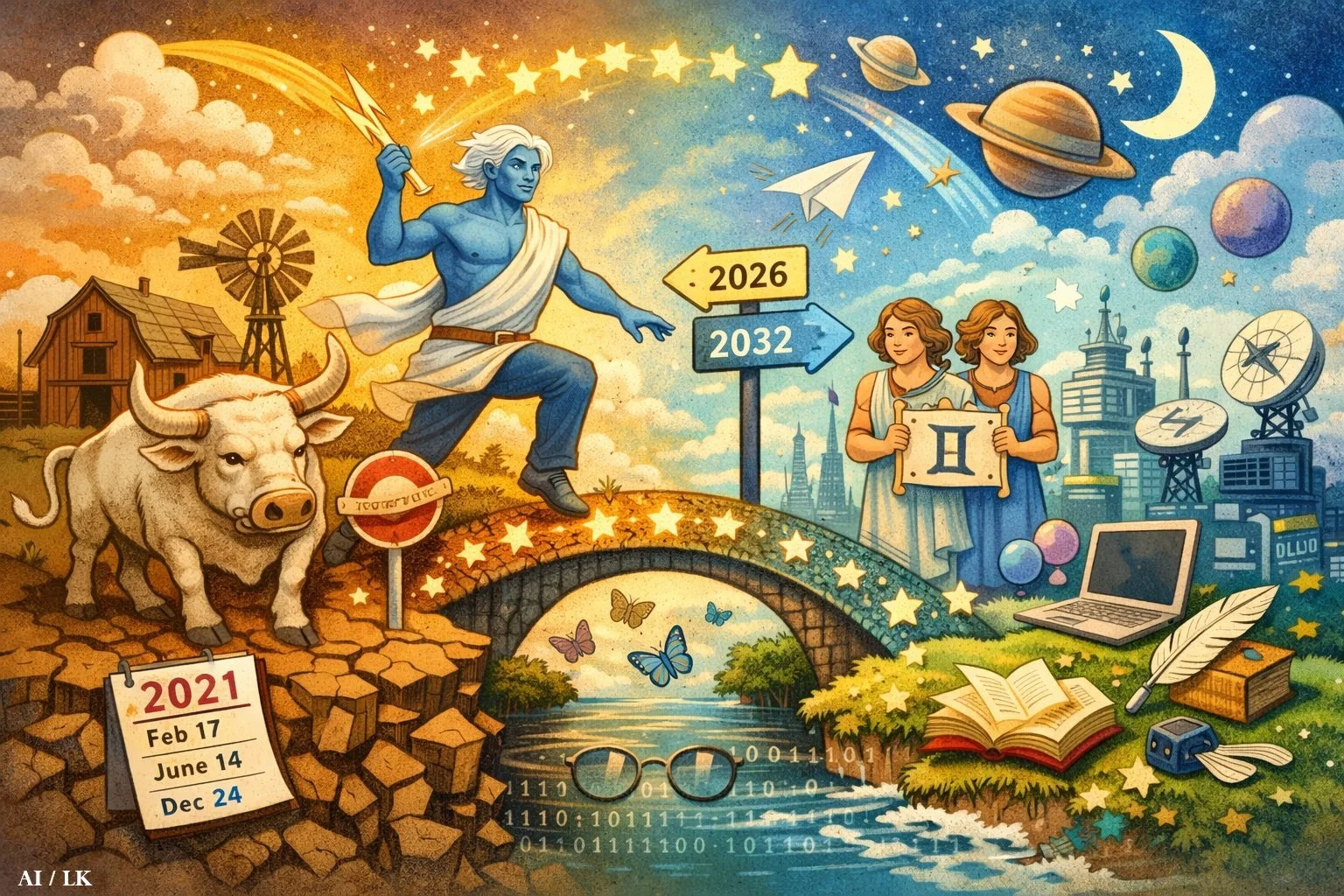
Uranus stations direct in Taurus for the final time today, bringing to a close one of the most consequential planetary transits of the past decade. Uranus first entered Taurus in mid-May of 2018, initiating a slow but relentless process of destabilization within the Fixed Earth realm of material security, economics, land, food systems, and the very idea of what is “stable.” Yet the most dramatic and archetypal phase of this nearly eight-year transit unfolded in 2021, when Uranus became locked in a historic standoff with Saturn.
At that time, transiting Saturn—the planet of structure, limits, and authority—was moving through Aquarius, the sign of radical collectivity, social systems, and technological futures. In a delicious cosmic irony, Aquarius is ruled both by Saturn (traditionally) and Uranus (modern), meaning the two planetary principles were essentially fighting over the same symbolic territory. Over the course of that year, Saturn made three exact hard squares to Uranus in Taurus: February 17, June 14, and December 24, 2021. These dates marked pressure points in a global ideological struggle between the impulse to radically disrupt entrenched systems and the counter-impulse to enforce order, control, and coherence.
Uranus, the planet of shocks, revolutions, and awakenings, found itself lodged in Taurus, the most conservative and resistant of the zodiac signs. Saturn, the great limiter, was positioned in Aquarius, the sign of “the people,” progressivism, and collective reform. The symbolism could not have been more perfect. Uranus in Taurus manifested as radical conservatism—sudden, destabilizing reactions emerging from the desire to preserve what feels threatened. Saturn in Aquarius expressed as constricted revolution—attempts to systematize, regulate, and contain social change. A square, after all, is a right angle; you cannot see around the corner without a mirror. In the United States especially, this aspect mirrored a cultural and political reality in which conservatives became radicalized in response to what they perceived as organized chaos bearing down on them and on society itself. Radical impulses sought to conserve; revolutionary energies became disciplined, surveilled, and constrained.
Now, as Uranus stations direct in the final degrees of Taurus—after having been retrograde since early September—he prepares for his eventual ingress into Gemini in late April 2026. This shift cannot be overstated. Gemini is the sign of communication, language, media, networks, and information systems, while Uranus rules technology, innovation, and disruption. When Uranus enters Gemini, we are entering an entirely new historical phase. By the time this transit ends in July 2032, we will almost certainly look back on the present moment as “the good old days,” which is absurd, considering that no one today would describe our era that way. Yet this is exactly how technological revolutions work: they feel chaotic in retrospect, even if they feel unbearable while we are inside them.
What lies ahead is nothing less than a radical restructuring of communication itself. While Uranus travels through Gemini, he will form a long-term trine with Pluto in Aquarius through 2029—a power aspect that signals deep, irreversible transformations in collective systems, digital infrastructure, and social reality itself. At the same time, Uranus will maintain a supportive sextile to Neptune in Aries through 2027, blending technological innovation with imagination, myth, spiritual longing, and visionary narratives. Then, as if to formalize the entire process, Saturn will eventually join Uranus in Gemini in May 2030. After years of tension and ideological warfare, Saturn and Uranus will finally occupy the same sign, symbolizing a period in which innovation and structure are forced into dialogue. For once, the revolution and the system will be speaking the same language—at least through July 2032.
One of the most volatile periods ahead will occur when transiting Uranus conjuncts the natal Uranus of the United States at 8 degrees Gemini. This will happen in three waves: July 2027, November 2027, and May 2028. Uranus–Uranus transits are classic markers of radical resets, generational awakenings, and abrupt shifts in identity. Because this conjunction occurs close to the U.S. Descendant at 13 Gemini, it strongly suggests disruptive changes in alliances, partnerships, and political configurations—possibly even a rupture in the very idea of who the “other” is in American life.
But from a Jewish astrological perspective, Taurus occupies a far more sacred and paradoxical position than is usually acknowledged. Taurus corresponds to the Hebrew month of Iyar, the only month that is entirely filled with the counting of the Sefirat HaOmer, the forty-nine-day spiritual ladder that begins on the second night of Pesach and culminates on the eve of Shavuot. The Omer is not merely a ritual—it is a theology of time itself. Each night we count a day, we name it, we associate it with a specific sefirah, and in doing so we transform duration into sanctified consciousness. Time is no longer something that simply passes; it becomes something that ascends.
This places Taurus at the very heart of sacred temporality. And that role is further emphasized by Issachar, the tribal ruler of Taurus, whose defining gift was the ability to discern and keep holy time. The Torah describes Issachar as those “who knew how to read the times,” and the Midrash tells us that his tribal banner bore the Sun and the Moon—the cosmic instruments of calendrical order. Issachar was not tasked with predicting the future, but with aligning earthly life with celestial rhythm, ensuring that sacred cycles remained intelligible, coherent, and spiritually anchored.
Seen through this lens, Uranus in Taurus becomes one of the most paradoxical transits imaginable. Uranus ruptures continuity; Taurus is entrusted with preserving it. Uranus disrupts time; the Omer consecrates it. Uranus accelerates; Issachar stabilizes. What has been under pressure during this entire transit is not merely material systems, but the human capacity to remain faithful to sacred time in an age that is actively dissolving time itself.
So as Uranus moves through the final anaretic degrees of Taurus, the familiar traits of the sign—stubbornness, resistance, caution—take on an entirely different spiritual valence. At the twenty-ninth degree, the essence of a sign intensifies and distills. In Taurus, this can indeed manifest as extreme rigidity. But it can also be consciously elevated into something far more luminous: faithfulness instead of inertia, discernment instead of fear, continuity instead of collapse.
As Uranus prepares to leave Taurus behind, the question is not whether change is coming—it is. The deeper question is whether, in the midst of technological rupture and historical acceleration, we can still count our days, name our moments, and remain aligned with a sacred rhythm that does not disappear simply because the world is moving faster than it ever has before. In that sense, Taurus is not the sign resisting the future. It is the sign quietly protecting the calendar of the soul while the future is being rewritten.