Pluto and the Ruined Judge: A Karmic Reading of the Trump–Epstein Charts
When I examine the synastry chart between Donald Trump and Jeffrey Epstein, I am not struck by anything casual, social, or even conventionally “relational.” This is not the astrology of two men who merely crossed paths within the same elite circles. The chart does not describe acquaintanceship. It describes entanglement.
The geometry of the synastry chart itself is heavy with nodal, Plutonian, and angular contacts, the kind that belong to karmic bonds rather than chance encounters. Whatever occurred between these two men, astrologically speaking, was not optional. It was structurally embedded.
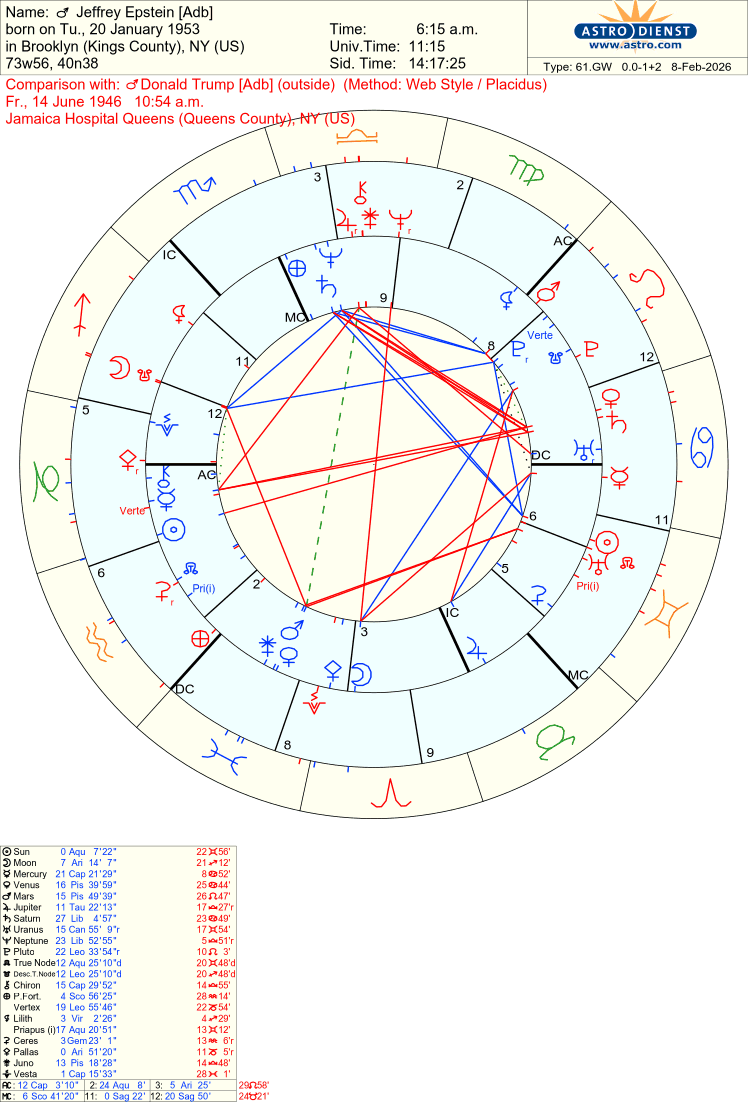
Donald Trump (outside, red) Synastry Chart with Jeffery Epstein (inside, blue)
The most arresting feature of the synastry is Trump’s natal Pluto in Leo sitting directly on Epstein’s South Node, and therefore in opposition to Epstein’s North Node in Aquarius. This is classic karmic power symbolism. Pluto on the South Node suggests a pre-existing script around dominance, control, and shadow material being reactivated through the relationship. It is not simply influence; it is regression into an old pattern. Trump’s Pluto plugs directly into Epstein’s past-life axis, pulling him backward into a Leo power theater rather than forward along his Aquarian evolutionary path. In mythic terms, this is not a meeting between equals. It is an encounter with an underworld lord who activates unfinished business.
This karmic dynamic is reinforced by the presence of Trump’s Asteroid Ceres, the underworld mother archetype, conjunct Epstein’s North Node in Aquarius. Ceres is not sentimental motherhood; she governs nourishment, dependency, and control through provision. In the Persephone myth, she descends into hell not for romance, but because Hades, King of the Underworld, has taken her daughter – what and who she feeds and sustains. Epstein’s life path intersecting Trump’s Ceres suggests a relationship structured around supply chains, facilitation, and invisible economies of provision—who feeds whom, who connects whom, who maintains the ecosystem. This is not intimacy in the emotional sense. It is infrastructure karma which features the image of a young woman – Persephone, the daughter of Ceres and the focal point of the Ceres myth.
Ceres was the first of the asteroids to be discovered and the only one visible to the naked eye. Symbolically, this Ceres / North Node conjunction has been visible all along in their relationship.
Overlaying all of this is a sexual and psychological power geometry involving Pluto, Mars, Venus, Saturn, and Neptune, with heavy activation of the 7th, 8th, and 12th houses. This is the architecture of secret bonds, dominance hierarchies, and shared shadow worlds. Epstein’s Mars–Venus conjunction in Pisces shape-shifts into whatever the other desires, while Trump’s Libra Juno–Chiron–Jupiter configuration receives it without ever truly perceiving the subject behind the function. Epstein adapts; Trump projects. One becomes a facilitator of pleasure and access; the other remains largely blind to the inner reality of the person enabling it. The relationship runs on asymmetry and misrecognition.
Taken as a whole, the synastry does not describe friendship, partnership, or even mutual exploitation in the ordinary sense. It describes a closed karmic system, powered by Pluto, lubricated by Neptune, and stabilized by Saturn, in which each man occupies a role rather than meets the other as a full subject. It is less the chart of two individuals than the chart of a power ecosystem with assigned functions. And it is within this gravitational field—this Plutonian architecture of dominance, supply, and secrecy—that Epstein’s own natal chart must ultimately be read.
Regrettably, Epstein was Jewish, so I am obligated—whether I like it or not—to also look at this chart through a Jewish astrological and spiritual lens. And when I do, what I see is not simply a villain’s horoscope, but something far more unsettling: a modern tragedy in the classical sense. This is not a chart that feels inherently demonic. It feels misallocated. Misdirected. Like a soul that fell not from mediocrity, but from potential.
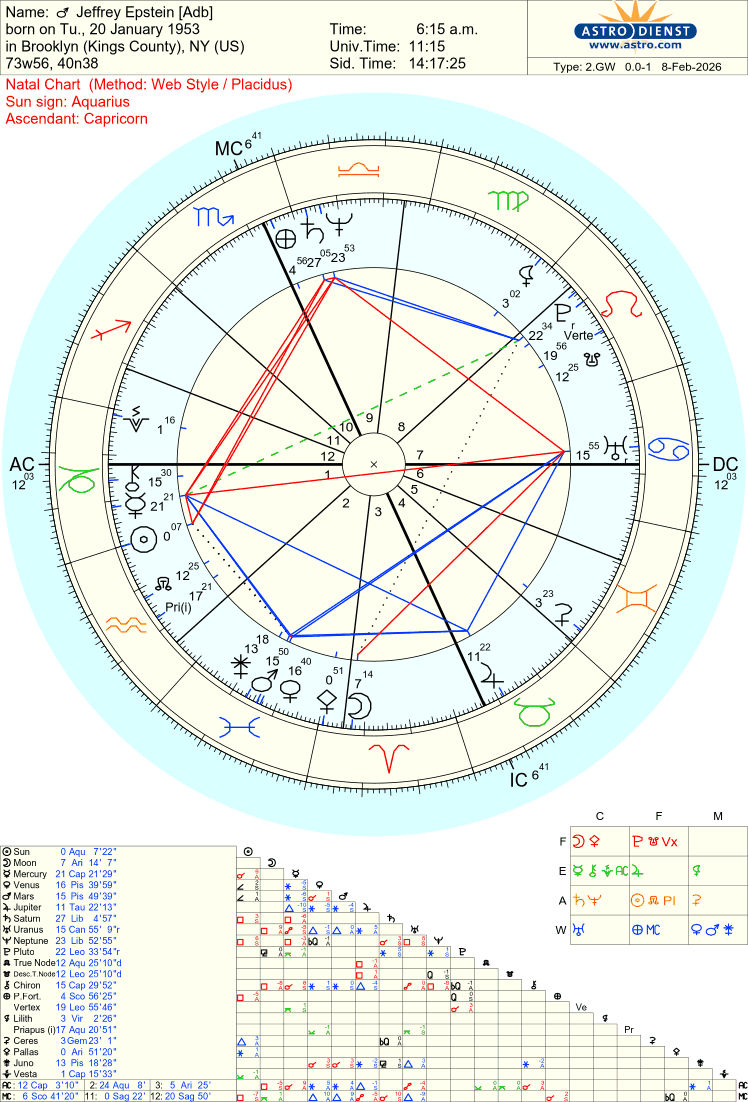
Jeffery Epstein Natal Chart
Stripped of biography and scandal, Epstein’s natal chart reads like that of someone who, in another time and place, might have lived a very different destiny. Capricorn rising is not merely ambition or social climbing. In Jewish astrological language, Capricorn corresponds to Din—judgment, גבורה crystallized into structure. This is the mazal of law, boundaries, authority, and moral architecture. A Capricorn Ascendant is the signature of someone born with an intrinsic relationship to משפט: the capacity to hold order for others, to sit in judgment, to discern right from wrong within systems larger than the self. This is the ascendant of judges, halachists, legal minds, people who are meant to carry responsibility rather than evade it.
Add to this Epstein’s Mercury in Capricorn, and the picture sharpens rather than softens. This is not the mind of a trickster or a hustler. It is a legal mind. Structured cognition. Formal reasoning. The ability to hold complex systems, hierarchies, and rules in working memory. In another incarnation, under different teachers and a different spiritual ecology, this is the mind of a Talmudist, someone capable of navigating massive conceptual architectures, parsing contradictions, and sustaining intellectual discipline over years of study. This is not the chart of a chaotic person. It is the chart of someone who could have lived inside law.
Indeed, as another great Jew has said: “To live outside the law, you must be honest.”
Then there is the Venus–Mars conjunction in Pisces in the third house, and here the tragedy becomes almost painful to contemplate. Pisces in Jewish astrology is not simply fantasy or escapism; it is the realm of hidden waters, ruach, intuitive perception, something close to prophetic sensitivity. Venus and Mars there, in the house of speech, listening, and perception, describe someone with an instinctive ability to sense what is unspoken in others. The kind of person who can feel when someone is lying, who picks up on emotional undercurrents, who understands human vulnerability without needing it to be explicitly articulated.
In a rectified life, this is the signature of a Dayan who can read testimony and know when to be strict and when to be merciful. A תלמיד חכם who hears the truth beneath the words. Someone whose intuition serves justice rather than manipulation. This is a Ruach–Binah configuration: instinct married to discernment, feeling integrated with judgment.
Which is precisely why the chart feels tragic rather than simply criminal. Because what appears here is not the absence of moral capacity, but its inversion. The tools of judgment, intuition, and structured intelligence are all present. What is missing is Torah as containment. Without Torah anchoring, Din becomes control. Ruach becomes shapeshifting. Sechel becomes rationalization. The same faculties that could have produced a judge of truth instead generate an architect of hidden systems. The intuitive reader of souls becomes an intuitive reader of vulnerabilities. The man who could have sat in a Beit Din becomes someone who built an underground economy of human weakness.
From a Kabbalistic perspective, this looks like a soul saturated with גבורה but insufficiently integrated with חסד. Enormous structural power, but no moral containment. So the gifts descend into the קליפות—the shells of the same faculties. Not evil by nature, but ungrounded. Unrectified. Din without mercy, intuition without ethics, intelligence without covenant.
And this is why, through a Jewish lens, Epstein’s chart feels less like the horoscope of a monster and more like that of a ruined judge. The deepest tragedy is not that someone falls, but that someone falls from a very high spiritual potential. A petty criminal is banal. A corrupted soul with the capacity for אמת is something else entirely. This is not the story of a man who never had access to light. It is the story of someone who, structurally, could have carried it—and instead built a shadow world with the same tools. That is what makes the chart so unsettling. Not the darkness itself, but the unmistakable outline of what might have been.
“Entanglement” by B. Louvat